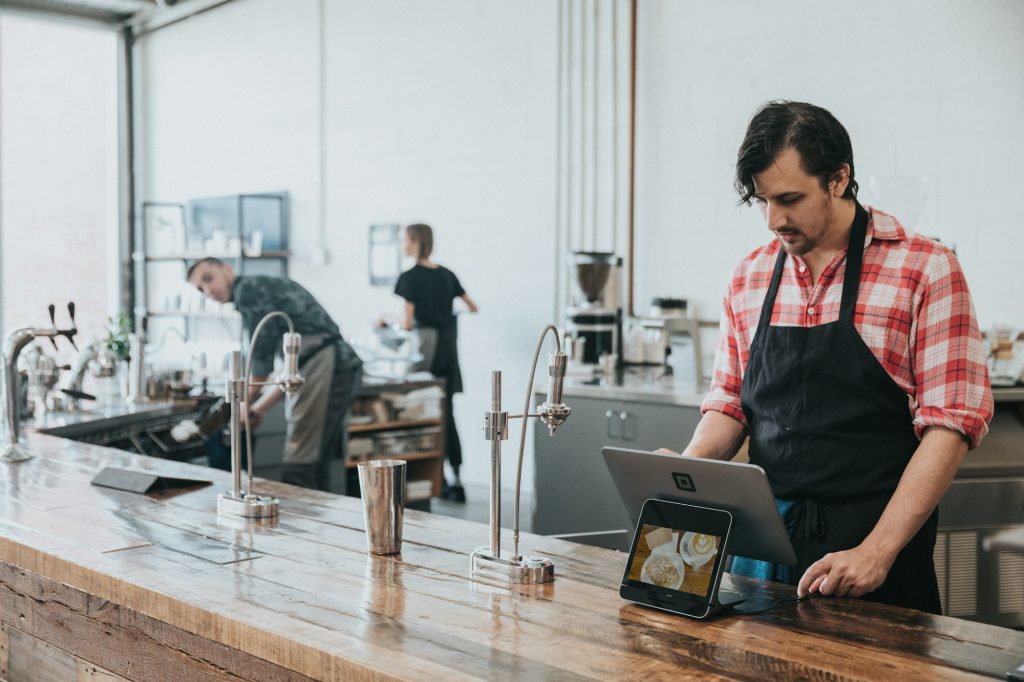
So, how much do coffee shop owners make? The best survey we found puts the average independent coffee shop owner at about $48,000 a year, with a median closer to $40,000. Fresh Cup’s owner salary survey of 155 U.S. coffee business owners found coffee shop owners averaged $48,234 in 2022. Toast passes along a wider range of $60,000 to $160,000 a year for small-to-medium shops. Your real number depends on two things: how much you sell and how much of each dollar you keep. This guide gives you the numbers and the math so you can run it for your own shop.
Still working out the upfront side? Start with how much it costs to open a coffee shop, then come back here for the payoff side.
How much do coffee shop owners make? The published numbers
Here’s what the sources we checked say. They measure different things (owner pay vs. shop profit, small surveys vs. broker data), which is why they don’t line up perfectly.
| Source | What it says |
|---|---|
| Fresh Cup survey | Coffee shop owners averaged $48,234 in 2022 (salary plus profit distributions). Median about $40,000 for owners of one type of coffee business. 155 U.S. respondents. |
| Toast | $60,000 to $160,000 a year for owners of small-to-medium shops (citing Chron). Notes owner pay is usually less than half of total profit. |
| BizBuySell | Average coffee shop and cafe: $730,199 in revenue and $65,718 in pre-tax net profit (9%) in 2021. In 2020: $769,494 and $53,865 (7%). |
| U.S. Bureau of Labor Statistics | $69,390 median wage for food service managers (May 2025). Not owners, but a good “what would I pay someone to run it” benchmark. |
Treat these as a starting range, not a promise. The Fresh Cup survey found owners of businesses under three years old reported lower pay, and about 10% of owners said they keep their own wages low on purpose. Most new owners put early profit back into the shop.
Why the numbers are all over the place
- Owner pay vs. shop profit. Some figures count only what the owner takes home. Others count the profit the shop earns. If you own 100% of the shop, both are yours.
- Working owner vs. hands-off owner. If you pull shots and run the schedule, part of your income is really a manager’s wage. If you hire a manager, that money goes to them.
- Format. A coffee cart, a drive-thru and a sit-down cafe with a food menu have very different sales and costs.
- One shop vs. several. Fresh Cup found the owners earning $100K+ tended to have slightly older businesses and more locations. Averages blend everyone together.
So don’t chase one magic number. Figure out what your shop can make.
The simple math: sales times net margin
Owner take-home ≈ what you pay yourself + (annual sales × net profit margin)
Margins vary a lot by source. BizBuySell shows 7% to 9% pre-tax for the average shop. Toast cites an average profit margin of 15% to 25%, and its own worked example shop lands at 9.3% at full capacity. Here’s what different sales levels and margins work out to. It’s just arithmetic, not a forecast.
| Annual sales | 5% margin | 10% margin | 15% margin |
|---|---|---|---|
| $250,000 | $12,500 | $25,000 | $37,500 |
| $400,000 | $20,000 | $40,000 | $60,000 |
| $600,000 | $30,000 | $60,000 | $90,000 |
| $800,000 | $40,000 | $80,000 | $120,000 |
That profit is on top of any wage you pay yourself for working in the shop. For a deeper look at margins, read our guide to the average coffee shop profit margin.
Where each dollar goes in a coffee shop
Margin is what’s left after costs, so it helps to know the big buckets. These are common planning ranges from the sources we checked:
- Food and beverage cost: about 30% to 35% of sales (Toast). Lightspeed gives 28% to 35%.
- Labor: about 24% to 40% of sales (Toast). Lightspeed suggests keeping prime cost (food plus labor) at or under 60% to 65% of revenue.
- Rent: Sage (writing for UK shops) suggests keeping rent under 15% of sales. A lease that eats more than that squeezes everything else.
- Marketing: about 3% to 6% of sales (Toast).
- All operating costs together: Toast estimates 75% to 85% of monthly sales, which is how you end up with margins in the teens or lower.
A worked example: a $400,000-a-year coffee shop
Let’s run one shop through the math. These are example numbers built from the ranges above, not a prediction for your shop. Swap in your own.
- Annual sales: $400,000 (about $1,100 a day if you’re open every day)
- Food and beverage cost, 30%: $120,000
- Labor, 30%: $120,000 (prime cost 60%, right at the line Lightspeed suggests)
- Rent, 10%: $40,000
- Utilities, insurance, card fees, marketing, repairs, loan payments and everything else, 20%: $80,000
- What’s left: $40,000, a 10% net margin
Now the big question: who runs the shop? If you work as the manager yourself, you’re doing a job that might otherwise cost something near the BLS median of $69,390. You can pay yourself a wage (it sits inside that labor line) and still keep the $40,000 profit. If you hire a manager instead, that wage goes to them and your owner income is the $40,000.
What does $1,100 a day look like? If your average ticket were $7 (use your own number from your menu), that’s about 157 orders a day. Run your real menu prices through the free Coffee Shop Menu Price Calculator, then test your daily sales target with the Coffee Shop Break-Even Calculator.
Want this done for you?
The Coffee Shop Launch Plan ($29) gives you the Startup Budget Calculator, the Drink Cost Calculator and a business plan template (Word + PDF), plus the rest of the 10-file plan. Plug in your numbers and see what your shop needs to sell.
How long before you pay yourself back
Your startup cost matters here too. Crimson Cup lists these 2026 ranges:
| Format | Startup cost (Crimson Cup) |
|---|---|
| Kiosk, stand or mobile cart | $90,000 to $150,000 |
| Drive-thru only | $100,000 to $250,000 |
| Seating only | $100,000 to $350,000 |
| Seating plus drive-thru | $120,000 to $400,000 |
Quick math: if you spend $150,000 to open and the shop clears $40,000 a year, it takes almost four years for profit alone to cover that investment. Crimson Cup also suggests having cash on hand for the first six months after opening. Build that cushion, plus a personal runway line for your own bills, into your budget before you sign a lease. The free Coffee Shop Startup Cost Calculator gives you a low-to-high number in a couple of minutes.
How coffee shop owners actually get paid
Profit on paper isn’t cash in your pocket until you move it out. Owners usually get paid in one or more of these ways:
- A salary or wage. You’re on payroll like your baristas. If your shop is an S corporation, the IRS says it must pay reasonable compensation to a shareholder-employee for their work before taking non-wage distributions.
- An owner’s draw. Common for sole proprietors and many LLCs. You take money out as the shop can afford it.
- Profit distributions. What’s left after costs, split among owners by ownership share.
Tax rules depend on your structure and your state, so talk to a CPA before you pick. Decide your structure early, because it shapes how you can pay yourself later.
What moves your income the most
- Sales volume. Every number above scales with sales. Pick a location with the foot or car traffic to support your daily order target.
- Drink pricing. Price every drink from its real cost (beans, milk, syrup, cup, lid) instead of matching the shop down the street.
- Average ticket. A pastry or breakfast item with a coffee lifts the ticket without adding a new customer. Watch food cost so it doesn’t drag your margin.
- Labor scheduling. Staff to your rush hours, not to a flat schedule. Labor is the line with the widest range.
- Rent. A lease that fits your sales is the easiest cost to control, because you only negotiate it once.
- Startup spend. Every dollar you don’t borrow is a loan payment you don’t make. A former cafe space can save a big chunk of build-out.
- More locations. The highest earners in the Fresh Cup survey tended to have more than one.
Your owner income checklist
- Write down the yearly income you actually need to live on.
- Price your menu and find your real average ticket.
- Work out daily sales needed to cover costs plus your pay.
- Decide if you’ll work in the shop or hire a manager.
- Pick a business structure with a CPA.
- Budget at least six months of operating cash and personal runway.
- Set aside money for taxes every time you pay yourself.
- Review your P&L every month and fix the biggest leak first.
Thinking about a bigger concept? Here’s the same breakdown for how much restaurant owners make and how much bar owners make. Prefer to start small? Read our guide to the mobile coffee cart business.
Want a head start for free? Grab the Free Coffee Shop Starter Kit below.
FAQ
How much do coffee shop owners make a year?
Fresh Cup’s survey of 155 U.S. coffee business owners found coffee shop owners averaged $48,234 in 2022, with a median around $40,000. Toast cites $60,000 to $160,000 for small-to-medium shops. Your number depends on sales, net margin and whether you also pay yourself a wage.
What is the average profit margin for a coffee shop?
It depends on the source. BizBuySell shows a pre-tax net margin of 7% to 9% for the average coffee shop and cafe in 2020 and 2021. Toast cites an average profit margin of 15% to 25%. Food and labor together near 60% to 65% of sales is a common ceiling.
Is owning a coffee shop profitable?
It can be. BizBuySell’s average shop earned $65,718 in pre-tax profit on $730,199 in sales in 2021. Shops with enough daily volume, drinks priced from real costs and a lease that fits their sales have the best shot.
How do coffee shop owners pay themselves?
Through a salary or wage, an owner’s draw, profit distributions or a mix, depending on business structure. If the shop is an S corporation, the IRS requires reasonable compensation for an owner who works in the business before non-wage distributions. Talk to a CPA before you decide.
How long before a coffee shop owner gets paid?
Often longer than people expect. Fresh Cup found owners of businesses under three years old reported lower pay, and many owners reinvest early profit. Crimson Cup suggests having cash for the first six months after opening, so build personal runway into your budget too.
Your next step
Run the numbers on your own coffee shop this week. The $29 Coffee Shop Launch Plan gives you 10 files: Start Here guide, business plan template (Word + PDF), launch checklist, business structure guide, permits roadmap + permit tracker, insurance cheat sheet, Startup Budget Calculator and Drink Cost Calculator. 30-day money-back guarantee.
