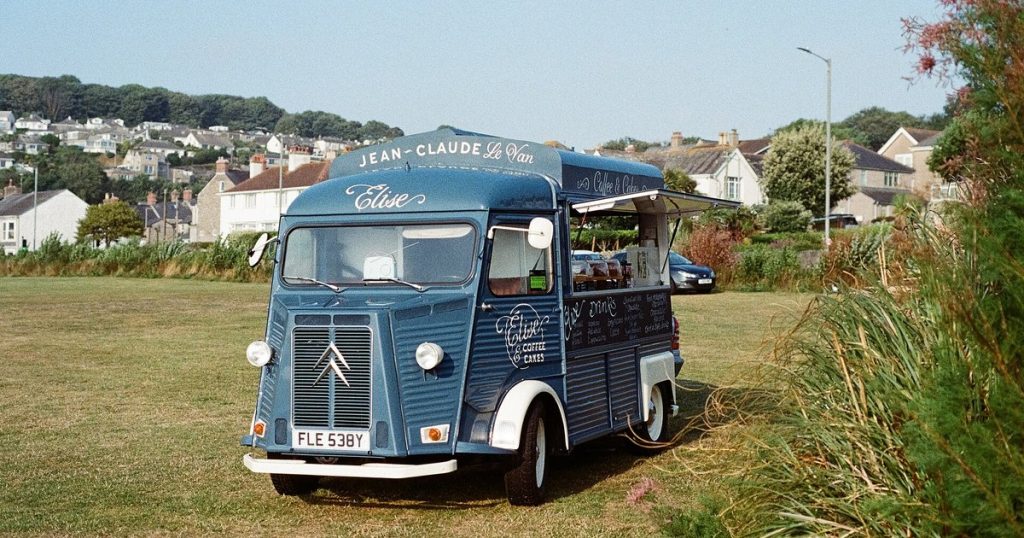
A mobile coffee cart business is the cheapest real way into specialty coffee. Not cheap as in flimsy. Cheap as in a fraction of what a coffee shop costs. Industry cart builder Cart-King puts coffee cart startup costs at $24,000–$49,000, against $125,000–$400,000 for a brick-and-mortar cafe. Same espresso. Same customers. One tenth the lease risk.
This guide walks you through what a mobile coffee cart business actually costs in 2026, the equipment you need, the permits that trip people up, realistic revenue math, and the exact steps to launch. Every number here comes from a linked source. No guesses.
Why a coffee cart beats a coffee shop in 2026
The case for the cart is simple: less capital in, faster path to breaking even, and you can move if a location flops.
- Lower buy-in. Per Cart-King’s 2026 cost guide, a cart requires 65–75% less capital than a coffee food truck and 85–90% less than a brick-and-mortar cafe.
- Faster break-even. The same guide reports most coffee cart operators reach break-even within 3–6 months, versus 12–24 months for traditional cafes.
- No lease trap. A cafe locks you into a multi-year lease with monthly rent and utilities that Cart-King pegs at $4,000–$15,000. A cart lets you test locations before you commit to any of them.
- One-person operation. A cart is built for a single operator. Your labor line can be zero until you decide to grow.
If you end up wanting the full build-out later, our hub on how to open a coffee shop covers that path step by step. But if capital is tight, start here.
Still deciding between a cart, a drive-thru, and a full cafe? Take the two-minute coffee shop concept quiz — it weighs your budget and market and tells you which format actually fits.
What a mobile coffee cart business costs to start
Here is the honest range: $24,000 to $49,000 all-in, per Cart-King’s complete financial breakdown. Where you land inside that range depends on your cart, your machine, and how many months of working capital you bank before day one.
Cart-King’s typical entry budget ($24,000) breaks down like this:
| Line item | Typical ($24,000 build) | Premium ($49,000 build) |
|---|---|---|
| Coffee cart (branded) | $6,000 | $18,000 (new custom) |
| Commercial equipment | $6,500 | $12,000 |
| Permits and licensing | $1,500 | $2,500 (multiple locations) |
| Starting inventory | $1,200 | $1,500 |
| Working capital | $3,500 (4 months) | $5,000 (6 months) |
| Insurance | $800 | $1,200 |
| Setup and modifications | $2,000 | — |
| Marketing and branding | $1,500 | $3,000 |
| POS and technology | — | $1,500 |
| Contingency reserve | $1,000 | $2,300 |
The cart itself is the biggest swing. Cart-King prices basic new commercial carts (6–8 feet of counter, basic electrical, storage, wheels) at $4,000–$10,000, and fully custom builds with stainless steel, plumbing, integrated refrigeration, and branding at $15,000–$25,000. Setup and modification work runs $500–$1,500 basic, up to $4,000–$8,000 for a premium build-out.
Before you spend a dollar, run your own numbers in our free coffee shop startup cost calculator and see the full picture in how much it costs to open a coffee shop. A cart is the low end of the same spectrum.
Coffee cart vs. coffee truck vs. coffee shop
People shopping a mobile coffee cart business are usually cross-shopping a coffee truck. The gap is bigger than most expect.
| Model | Startup cost | Source |
|---|---|---|
| Coffee cart | $24,000–$49,000 | Cart-King |
| Coffee truck | Starts around $60,000; used trucks $30,000–$70,000, new builds $50,000–$175,000, plus $10,000–$20,000 in coffee equipment | Toast |
| Brick-and-mortar cafe | $125,000–$400,000 | Cart-King |
Cart-King’s truck range ($71,000–$198,000) runs even higher than Toast’s floor. Either way, the cart wins on cash-at-risk. The truck wins on range and weather protection. The shop wins on seating and evening business. Start where your bank account is, not where your ego is.
The equipment you actually need
Equipment is where quality lives, and it is the second-biggest line in the budget. All pricing below is from Cart-King’s equipment breakdown; our full coffee shop equipment list covers the shop-scale versions of the same gear.
Espresso machine: $1,500–$8,000
Entry commercial machines ($1,500–$3,500, think Rancilio Silvia Pro or Breville Dual Boiler) handle 30–60 drinks a day. Mid-range dual boilers ($3,500–$6,000) handle 60–100. Premium machines like a La Marzocco Linea Mini ($6,000–$8,000) are built for 80–150+ drinks daily and a 10+ year lifespan. Match the machine to your realistic volume, not your Instagram feed.
Grinder: $300–$3,000
Grind consistency matters more to cup quality than the machine does. Budget commercial grinders run $300–$600, professional units $600–$1,500, premium $1,500–$3,000. Do not cheap out below commercial grade; under-powered grinders fail fast.
Water system: $400–$2,000
Carts do not get a municipal hookup. You need a portable espresso kit: fresh water tank, waste tank, and a 12V pump. Basic kits run $400–$600 with 5–7 gallon tanks; custom integrated systems with filtration and hot water run $1,000–$2,000.
Refrigeration: $300–$2,500
Milk storage is a health-code requirement, not an option. Compact 3–4 cubic foot units start at $300–$600; larger 6–8+ cubic foot systems for a bigger menu run $1,200–$2,500.
Licenses and permits for a coffee cart
This is the part that stalls most first-time operators. Requirements stack across three levels of government, and they vary by state and county. The SBA’s licenses and permits guide is the right starting point for the federal and state layers. Expect some mix of:
- Business registration — an LLC or sole proprietorship, registered with your state, plus an EIN from the IRS.
- General business license — from your city or county.
- Mobile food vending / health permit — issued by your county health department. Your cart will be inspected. This is the permit that governs your water tanks, refrigeration temps, and handwashing setup.
- Food handler certification — for you and anyone serving.
- Commissary agreement — many counties require mobile vendors to prep and store at a licensed commercial kitchen. Ask before you buy the cart, not after.
- Event and location permissions — private property agreements, farmers market vendor slots, or special event permits.
Cart-King budgets $1,500 for a single-location permit stack and $2,500 if you plan to operate across multiple jurisdictions. Call your county health department first. One phone call now saves a five-figure mistake later.
Want the shortcut? The Coffee Shop Startup Kit is the startup budget calculator, the drink cost calculator, the pricing strategy guide, the menu engineering guide, the permits and licensing roadmap, the business structure guide, the insurance cheat sheet and the launch checklist. Built by a former Dickey’s Barbecue Pit CMO who has launched 10+ restaurant concepts. Tools, not theory.
How much can a mobile coffee cart business make?
Revenue depends on location, hours, and speed. Cart-King’s projection models give you three honest scenarios based on drinks per hour and a $5.50–$6.50 realistic average ticket:
| Scenario | Volume | Daily revenue | Monthly revenue |
|---|---|---|---|
| Conservative (new operator, 5 days/wk, 6 hrs/day) | 42 drinks/day | $252 | $5,544 |
| Moderate (3–6 months in, 6 days/wk, 7 hrs/day) | 78 drinks/day | $488 | $12,675 |
| Aggressive (optimized, 6 days/wk, 8 hrs/day) | 130 drinks/day | $845 | $21,970 |
New operators typically pull 8–12 drinks per hour at peak; optimized operators hit 20–25. That ramp is why the first two months feel slow and month six feels like a different business.
Those are revenue figures, not profit. Beans, milk, cups, commissary fees, insurance, and fuel come out before you pay yourself. For margin math on the shop side, see our breakdown of average coffee shop profit margin; the beverage economics carry over to carts.
These figures are third-party estimates for planning, not a guarantee of results. This is not financial advice. Your numbers will vary by market, location, and execution.
Get the Free Coffee Shop Starter Kit
Menu and margin cheat-sheet, startup budget calculator, and a printable worksheet. Free, no strings.
How to start a mobile coffee cart business in 7 steps
1. Nail the concept and menu
Small menu, done fast. Espresso classics, two or three signature lattes, cold brew, and one food item you can serve without cooking. Speed is your margin: at peak, every drink per hour you can add matters.
2. Write a one-page business plan
You need the math on paper before you spend: startup budget, average ticket, drinks per day to break even, and your top three locations. Our coffee shop business plan template works for carts; cut the build-out section and keep the rest.
3. Set the budget and funding
Pick your lane inside the $24,000–$49,000 range. One advantage of the cart model: the buy-in is small enough that many operators fund it with savings instead of loans. Run your scenario through the startup cost calculator first.
4. Buy the cart and equipment
Cart first, then machine, then grinder, then water system and refrigeration. Buy the grinder new. Consider a used espresso machine from a reputable tech with a service history, and confirm your cart’s electrical system can power everything you bolt to it.
5. Get permitted
County health department, business license, EIN, food handler card, commissary agreement if required. Start the health permit paperwork while your cart is being built; approvals can take weeks.
6. Lock your locations
A cart with no location is a very expensive espresso machine. Line up a weekday anchor (office park, hospital campus, university, transit stop) and weekend events (farmers markets, festivals, private bookings). Written permission for private property. Vendor applications for markets.
7. Launch loud and track everything
Soft-open at your anchor location, post your schedule on Instagram and Google Business Profile, and track drinks per hour and average ticket from day one. The moderate revenue model above is the target: get there by month four and you are ahead of Cart-King’s break-even curve.
Where a coffee cart makes money
The best coffee cart locations share three things: morning foot traffic, no nearby specialty coffee, and permission that is cheap or free. Proven spots: office complexes, farmers markets, college campuses, hospitals, gyms, car dealerships, church campuses on Sundays, and private events (weddings pay a flat fee, which beats per-cup risk). Rotate, measure, and double down on whatever your numbers say. Mobility is the whole point of a mobile coffee cart business; use it.
The ongoing costs nobody budgets
Startup cost is only half the math. Toast’s coffee truck cost guide flags the same ongoing lines that apply to carts: staffing and labor (with workers’ comp once you hire), continuous ingredient spend on beans, milk, syrups, cups, lids, sleeves and napkins, plus vehicle or cart maintenance. Coffee bean prices fluctuate, so operators who want a consistent margin per latte have to track their per-pound cost month to month instead of setting prices once and forgetting them.
Add the cart-specific recurring items from Cart-King’s budget: insurance (about $800–$1,200 a year in their models), permit renewals, commissary fees if your county requires one, and fuel or power for your generator. Build these into your break-even number before launch. A cart that covers its drink costs but not its overhead is a hobby, not a business.
Three mistakes that kill new carts
- Buying the cart before calling the health department. Counties differ on tank sizes, sink requirements, and commissary rules. If the cart you bought cannot pass inspection, you own expensive scrap. Spec the cart to your county’s checklist.
- Overspending on the machine, underspending on the grinder. Cart-King’s guidance is blunt: grind quality often matters more than machine quality for what ends up in the cup. A mid-tier machine with a professional grinder beats the reverse.
- Treating locations as fixed. The whole edge of a cart over a shop is that you can leave a bad spot. Track drinks per hour by location. If a spot underperforms for three straight weeks, move. Operators locked into a cafe lease do not get that option.
Mobile coffee cart business FAQ
How much does it cost to start a mobile coffee cart business?
$24,000–$49,000 all-in, per Cart-King’s 2026 financial guide. That covers the cart, commercial equipment, permits, starting inventory, insurance, and several months of working capital. A bare-bones setup with a used cart and entry-level machine can come in under the low end, but budget the full stack.
Is a mobile coffee cart business profitable?
It can be. Cart-King’s conservative model shows $5,544 in monthly revenue for a new part-time operator, scaling to $12,675–$21,970 as efficiency and locations improve, with most operators reaching break-even in 3–6 months. Profit depends on your costs and execution; nothing is guaranteed.
What permits do I need for a coffee cart?
Typically a business registration and EIN, a local business license, a mobile food vending or health permit from your county health department, food handler certification, and often a commissary agreement. Requirements vary by state and county; the SBA’s licenses-and-permits guide covers the federal and state layers.
Should I start a coffee cart or a coffee truck?
Start with the money: carts run $24,000–$49,000 (Cart-King), while coffee trucks start around $60,000 and can pass $175,000 for a new build (Toast). If your capital is under $50K, the cart is the realistic play. You can trade up to a truck once the cart proves your locations and menu. The same trade-off in food, with trailers added, is laid out in our truck vs trailer vs cart comparator.
Can one person run a coffee cart?
Yes. Carts are designed for single-operator service, which is a core cost advantage. One skilled operator can serve 15–25 drinks per hour at peak once dialed in. Add help only when a location’s line consistently outruns you.
Ready to open? Skip the blank-page phase. The Coffee Shop Startup Kit packs the budget, drink costing, pricing, permit and insurance files into one download that works for carts, kiosks, and full cafes. One-time purchase, 30-day guarantee.
Get the Free Coffee Shop Starter Kit
Menu and margin cheat-sheet, startup budget calculator, and a printable worksheet. Free, no strings.
