Most coffee shop equipment lists you find online are just that, lists. A wall of gear with no prices, no priorities, and no sense of what actually matters. That’s useless when you’re trying to build a budget. So this guide does the opposite: every category comes with a real 2026 price range, a note on what to buy first, and an honest take on where you can save and where you absolutely cannot.
Here’s the headline number to anchor on. A fully equipped coffee shop runs roughly $20,000 to $80,000 in equipment, with the core coffee setup, the espresso machine, grinders, and brewers, accounting for $8,000 to $50,000 of that. Where you land depends on your volume, your menu, and whether you serve food.
I spent years as CMO at Dickey’s Barbecue Pit and helped launch more than ten restaurants. The single most common way new owners blow their budget is buying the wrong gear in the wrong order, a beautiful espresso machine paired with a cheap grinder that bottlenecks every drink, or a full food-service kitchen for a shop that should have started as a drinks-only counter. This coffee shop equipment list is built to keep you from making those mistakes.
One note before the prices: these are 2026 industry ranges from the sources linked below, not quotes for your specific build. Your volume, your space, and new-versus-used decisions will move all of it. This is information to plan with, not financial advice.
Coffee shop equipment list: budget at a glance
Before the line items, here’s what total equipment spend looks like by tier, drawn from the Bellwether Coffee equipment guide:
A starter setup runs about $20,000 to $35,000, right for kiosks, tight budgets, and minimal menus. A standard full-service café with a real espresso bar lands at $35,000 to $55,000. A premium build with high volume, food service, or in-house roasting runs $55,000 to $80,000 or more, a range echoed by the Restaurant Warehouse equipment cost guide.
The mistake is treating every line on a coffee shop equipment list as equal. It isn’t. One rule from the Bellwether guide is worth tattooing on your forearm: put 40% to 50% of your entire equipment budget into the espresso machine and grinder. A $15,000 machine with a $3,000 grinder will out-perform a $25,000 machine with a $500 grinder every single time. The grinder is usually the real limiting factor on quality, and it’s the one people cut first.
If you want to see where equipment fits in the total launch budget, our breakdown of how much it costs to open a coffee shop covers rent, build-out, inventory, and everything else that stacks on top of the gear.
Coffee brewing equipment (don’t cut corners here)
This is your product. It’s the part of the coffee shop equipment list where saving money costs you customers.
Espresso machine: $5,000 to $35,000
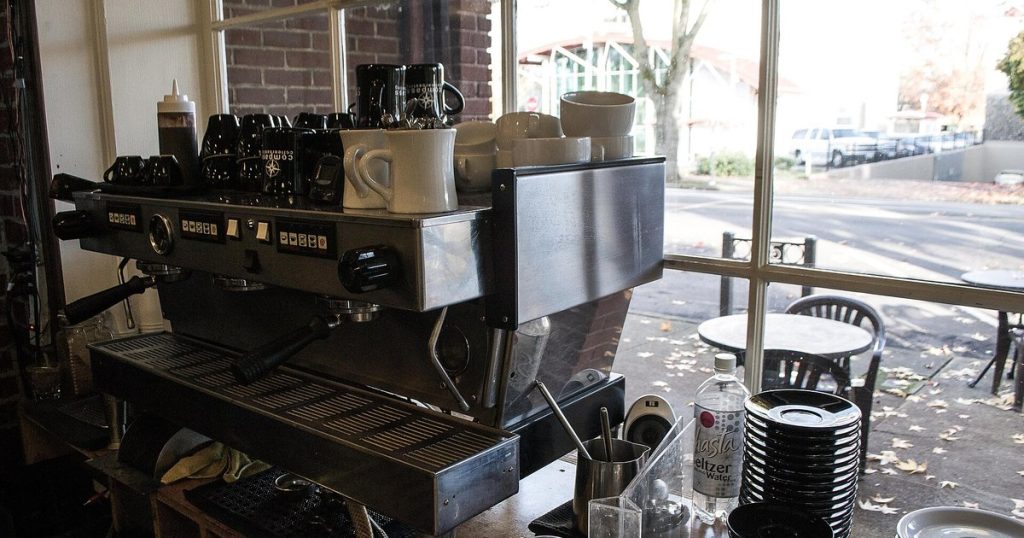
The heart of the operation, and you buy it based on expected volume. A 1-group semi-automatic for under 100 drinks a day runs $5,000 to $8,000. A 2-group for 100 to 250 drinks a day is $10,000 to $18,000. A 2-to-3-group commercial machine for 250 to 500 drinks lands at $15,000 to $25,000, and a multi-group or multiple-machine setup for 500-plus drinks a day runs $20,000 to $35,000 and up. Buy the best machine you can afford in your volume tier. It’s the piece customers notice most and it directly limits how fast your baristas can move.
Grinder(s): $1,500 to $8,000
Do not skimp here. An entry commercial grinder is $1,500 to $2,500, a mid-range model that suits most cafés is $2,500 to $4,000, and a high-end high-volume grinder runs $4,000 to $8,000. Buy two if you serve decaf, offer multiple espresso options, or want a backup when one fails mid-rush. A great grinder makes a mid-tier machine shine; a bad grinder wastes a great one.
Batch/drip brewer: $500 to $3,000
For drip service and larger orders. A standard commercial brewer is $500 to $1,500, a better temperature-controlled unit is $1,500 to $3,000, and a programmable specialty brewer like a Fetco or Curtis runs $2,500 to $5,000.
Cold brew and extras
Cold brew is increasingly expected. A simple immersion system is $100 to $500, a commercial setup is $500 to $1,500, and a nitro keg-and-tap system adds $1,000 to $3,000. Pour-over stations, gooseneck kettles, and scales add a few hundred dollars each if you offer manual brewing.
Refrigeration: $3,000 to $10,000
Reliable cold storage is non-negotiable. Under-counter refrigeration behind the bar runs $2,000 to $5,000. A reach-in refrigerator is $1,500 to $4,500. A refrigerated pastry display case is $1,500 to $4,000, and a grab-and-go cooler for bottled drinks is $2,000 to $5,000. An ice machine is essential for iced drinks at $1,500 to $8,000 depending on production rate, and don’t forget the ice bin (often sold separately) and water filtration.
Point of sale and technology: $1,000 to $3,000
Your POS affects every transaction. Square has low hardware cost ($0 to $800) but charges per transaction, Toast and Lightspeed run higher hardware plus a monthly fee, and Clover sits in between. For a coffee shop, prioritize speed of transaction, clean modifier handling for milk and size options, tip management, and loyalty. Budget another few hundred dollars for commercial WiFi, and consider security cameras ($500 to $2,000) and digital menu boards if your build allows.
Free resource: A coffee shop equipment list tells you what things cost. It doesn’t tell you whether your shop can afford them and still turn a profit. The Opening Day Kit Coffee Shop Startup Kit pairs this gear list with the startup budget calculator to size your equipment spend against your real revenue and rent. See what’s in the Coffee Shop Startup Kit.
Food service equipment (only if you actually serve food)
Here’s where new owners over-build. If you’re doing grab-and-go pastries, skip most of this. If you’re running a real food menu, a convection oven is $3,000 to $10,000, a panini press is $300 to $1,000, a flat grill is $1,000 to $3,000, and a refrigerated prep table is $1,500 to $3,000. You’ll also need either a commercial dishwasher ($2,000 to $8,000) or a 3-compartment sink ($500 to $1,500) to meet health code, and many cafés end up with both.
Adding food roughly doubles the complexity of your coffee shop equipment list and drags your margins. It can be the right call for traffic and ticket size, but make it a deliberate decision, not a default. Our guide to average coffee shop profit margin explains exactly how a food program changes your numbers.
Smallwares and essentials: $1,000 to $3,000
The little things that make a shift run. Barista tools, tampers, knock boxes, milk pitchers, shot glasses, thermometers, timers, and scales, total $500 to $1,500. Then add service items (ceramic cups, glassware, condiment stations), back-of-house storage shelving and containers, and the health-code required gear: sanitizer buckets, a first aid kit, and a fire extinguisher. None of it is exciting and all of it is mandatory, so build it in from day one instead of scrambling during your final inspection.
Furniture and customer space
Your seating sets the vibe and scales with your budget. Tables for a small café run $1,500 to $3,000 on the budget end and climb from there; chairs add $1,000 to $2,500; bar and lounge seating add more. Restaurant supply stores and used-equipment dealers are your friend here, and IKEA is a legitimate budget option. This is one area of the coffee shop equipment list where buying smart instead of premium has almost no effect on drink quality.
New vs. used: where to save
Used equipment can cut 30% to 50% off your coffee shop equipment list, but be selective. Refrigeration and dishwashers are usually fine secondhand. Espresso machines should be professionally serviced before you buy, and used grinders may need fresh burrs ($200 to $600). Skip used POS systems entirely, the technology moves too fast and you want current support. Buy the espresso machine and grinder new or certified; save your used-equipment hunting for the supporting cast.
Get the Free Coffee Shop Starter Kit
Menu and margin cheat-sheet, startup budget calculator, and a printable worksheet. Free, no strings.
How to actually sequence your purchases
If you’re building this from scratch, buy in this order. Lock the espresso machine and grinder first, because they define your quality ceiling and eat half the budget. Add refrigeration and the batch brewer next, since you can’t open without them. Layer in POS and smallwares, then furniture, then food-service gear last (and only if your concept truly needs it). Sequencing this way keeps you from spending on couches before you’ve nailed the part that actually sells.
Whatever you buy, map the full coffee shop equipment list against your startup budget before you place a single order. Our step-by-step guide to how to open a coffee shop walks through where equipment fits in the overall launch timeline so you’re not buying gear before your space is ready for it.
FAQ
What is the most important equipment for a coffee shop? The espresso machine and grinder. They directly determine drink quality and service speed, and you should put 40% to 50% of your equipment budget into the pair. A mid-priced machine with an excellent grinder beats an expensive machine with a cheap grinder, because the grinder is usually the limiting factor on quality.
How much does coffee shop equipment cost in total? Expect roughly $20,000 to $35,000 for a basic setup, $35,000 to $55,000 for a standard full-service café, and $55,000 to $80,000 or more for premium equipment or a food program. The core coffee gear, espresso machine, grinders, and brewers, typically accounts for $8,000 to $50,000 of that total.
What equipment do I need if I’m only serving drip coffee? A minimal drip-only setup is far cheaper. You need a commercial batch brewer ($500 to $3,000), a grinder ($500 to $1,500), airpots or carafes, milk refrigeration ($1,500 to $3,000), and a POS ($500 to $2,000), for a total around $3,000 to $10,000. Add espresso capability and you’re looking at $15,000 to $25,000 minimum.
Should I buy new or used coffee equipment? Used can save 30% to 50%, but inspect carefully. Refrigeration and dishwashers are often fine used. Have any used espresso machine professionally serviced first, and budget for new grinder burrs. Avoid used POS systems since the technology changes quickly. Buy your espresso machine and grinder new or certified when you can.
How much should I budget for the espresso machine alone? Match it to volume: $5,000 to $8,000 for a 1-group under 100 drinks a day, $10,000 to $18,000 for a 2-group at 100 to 250 drinks, and $15,000 to $35,000 for higher-volume 2-to-3-group or multi-machine setups. Prioritize reliability and local service availability over extra features.
Do I need a commercial coffee roaster? No, it’s optional. In-house roasting can reduce coffee costs and create a point of difference, and electric ventless roasters make it feasible without gas lines or exhaust, but it’s a significant added investment. Most new shops skip it at launch and revisit it once the core business is stable.
Build your equipment budget the right way
A coffee shop equipment list is only useful if it connects to your real numbers. Knowing an espresso machine runs $5,000 to $35,000 doesn’t tell you which tier your shop can afford while still hitting a healthy margin. That takes a budget.
The Opening Day Kit Coffee Shop Startup Kit gives you the startup budget calculator to turn this list into a plan you can actually fund, built from real launches instead of theory. Check out the Coffee Shop Startup Kit and size your gear spend before you order anything.
The figures in this post are industry benchmarks and ranges from the sources linked above. They’re meant to help you plan, not to predict your specific costs, and nothing here is financial advice. Get real quotes for your own build.
Get the Free Coffee Shop Starter Kit
Menu and margin cheat-sheet, startup budget calculator, and a printable worksheet. Free, no strings.
